Top 10 Lawn Irrigation Equipment for Global Buyers
Choosing the right Lawn Irrigation Equipment requires more than comparing prices or counting features. Global buyers must consider climate, water pressure, soil texture, installation skills, replacement parts, and local service support. A rotary sprinkler may perform well on a large sports field. It may waste water in a small garden with poor pressure.
Dr. Bert McCarty, a respected turfgrass scientist, emphasizes a practical principle: “Uniform irrigation matters more than excessive irrigation.” This idea guides our selection of the top ten systems. Each product should distribute water evenly, resist outdoor wear, and support accurate scheduling. Smart controllers, drip lines, rotors, valves, filters, and pumps each solve different problems. Their value depends on the landscape, not only the product label.
Details matter. A clogged filter can weaken an entire drip system. A poorly adjusted nozzle can leave dry patches beside flooded grass. Buyers should check flow rates, connection sizes, voltage requirements, warranty terms, and replacement availability before ordering internationally. Standards and installation rules also differ between markets. Professional advice remains important.
No ranking is perfect. Some affordable systems offer surprisingly strong performance. Some premium units still disappoint when installation is careless. This guide compares practical strengths, limitations, maintenance needs, and operating conditions. It aims to help importers, contractors, distributors, and property owners make informed decisions. The best equipment is not always the most advanced. Sometimes, it is the system that works reliably on an ordinary Tuesday morning.
Define the Top 10 Equipment Categories Using EPA WaterSense Criteria
Top 10 Lawn Irrigation Equipment for Global Buyers
Define the Top 10 Equipment Categories Using EPA WaterSense Criteria
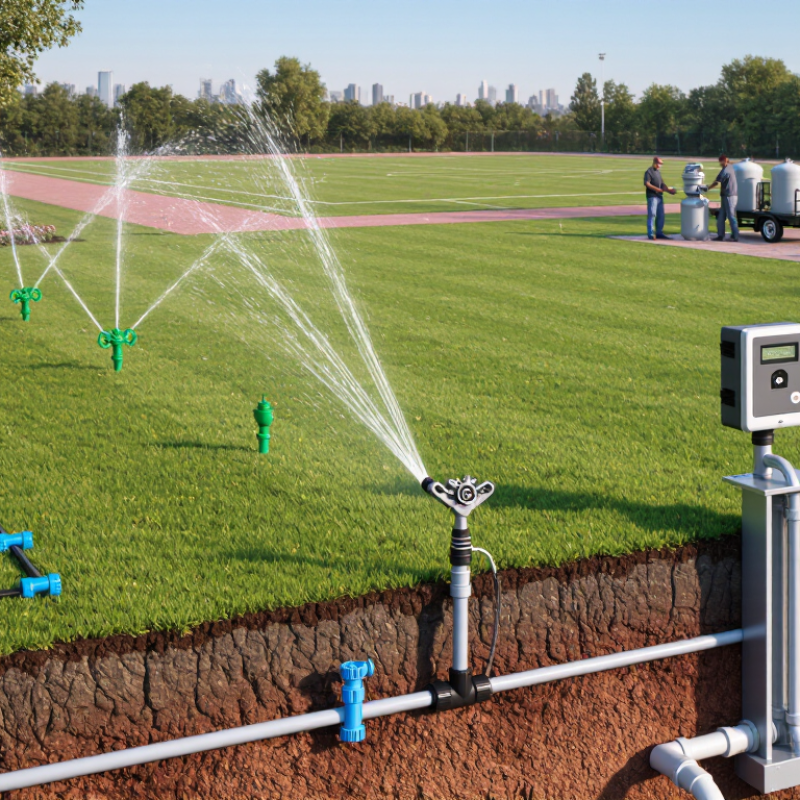
Outdoor irrigation uses more than 9 billion gallons of water daily in the United States, according to the U.S. EPA WaterSense program. The right equipment must control timing, pressure, coverage, and leakage. The ten main categories are smart irrigation controllers, soil-moisture sensors, weather stations, rain and freeze sensors, pressure-regulating sprinkler bodies, matched-precipitation spray heads, rotary sprinklers, drip irrigation systems, automatic control valves, and flow meters with leak detection. WaterSense criteria emphasize measurable efficiency, reliable field performance, and reduced overspray. A controller should respond to weather or soil conditions, not simply follow a fixed clock. That distinction matters.
EPA WaterSense reports that a labeled irrigation controller can save an average household nearly 8,800 gallons annually. Pressure-regulating sprinkler bodies also help maintain consistent distribution when supply pressure changes. Drip systems can place water near roots, while flow meters reveal broken lines or stuck valves early. These categories are not equally suitable for every landscape. Sandy soil, compacted soil, slopes, and windy sites require different layouts. The boundary between “smart” and genuinely efficient equipment is imperfect. A connected controller may still waste water when sensors are poorly installed. Buyers should review independent certification, operating pressure, replacement parts, climate compatibility, and installation guidance. The Irrigation Association’s technical resources also stress correct design and maintenance, because efficient hardware cannot repair poor spacing or neglected filters. Geological conditions remain easy to underestimate.
Compare Sprinkler Types by 25–60 psi Operating Pressure Ranges
Pressure determines sprinkler performance more than appearance. At 25 psi, spray heads produce gentle coverage for small lawns and narrow planting beds. Their average application rate can exceed 1.5 inches per hour, so short cycles help limit runoff. At 30–40 psi, rotary nozzles distribute water more slowly and evenly across larger areas. They are useful where clay soil absorbs water slowly.
Rotor sprinklers usually perform best between 40 and 60 psi. At 50 psi, many systems achieve longer throw distances, but excessive pressure can create mist and uneven coverage. Impact sprinklers often tolerate 45–60 psi and suit open lawns exposed to wind.
Drip-line zones need different controls; forcing them above 40 psi may damage fittings. Always check actual pressure at the valve, not only the pump rating. A basic gauge costs little and reveals surprising losses.
The U.S. EPA WaterSense program reports that landscape irrigation can represent nearly one-third of residential water use, with inefficient systems wasting up to half. The Irrigation Association also emphasizes pressure regulation and matched precipitation rates in efficient design. These figures support careful equipment selection, especially in dry regions.
One caveat. Soil, wind, nozzle spacing, and water quality can alter results more than catalog claims. A 60 psi supply may still deliver poor coverage through undersized pipes. Field testing with catch cans remains more reliable than visual inspection.
Evaluate Drip Irrigation at Typical 1–4 L/h Emitter Flow Rates
Among the top 10 lawn irrigation equipment choices, drip irrigation deserves careful evaluation at 1–4 L/h emitter flow rates. This range suits flower beds, shrubs, vegetable borders, and narrow planted strips. It delivers water near the root zone, reducing surface evaporation and overspray. A 1 L/h emitter works well in compact soil or closely spaced plants. A 4 L/h emitter may suit sandy soil, mature shrubs, or wider spacing.
Field experience shows that flow rate alone does not determine performance. Check operating pressure, filter quality, tubing length, and emitter spacing together. A pressure regulator helps maintain steadier output across long lines. Use a suitable filter when water contains fine particles. Flush the lines regularly. Small blockages can quietly create dry patches.
I once selected emitters by plant size only. That assumption was too simple. Soil texture changed the wetting pattern more than expected. For global buyers, test a short section before purchasing large quantities. Place small containers beneath several emitters and measure output for fifteen minutes. Uneven results may indicate pressure loss, poor filtration, or manufacturing variation. Installation on a slope also needs attention, because gravity can increase flow downhill. A practical system should allow easy inspection, seasonal adjustment, and replacement of individual parts. Some calculations may still need revision after observing real soil conditions.
Rank Global Equipment by Efficiency, Standards, Climate, and Total Cost
Top 10 Lawn Irrigation Equipment for Global Buyers
Global buyers should rank equipment by efficiency, standards, climate fit, and total cost. The strongest option is a weather-based smart controller, followed by soil-moisture sensors, pressure-regulating spray bodies, dripline, rotary sprinklers, flow meters, filters, efficient valves, variable-speed pumps, and rain sensors. This order can change by region. The U.S. EPA WaterSense program reports that weather-based controllers can save an average household nearly 9,000 gallons of water annually. However, savings depend on programming, soil, and maintenance.
Climate changes the ranking. Dripline suits dry zones and planting beds, while rotary sprinklers often perform better on large lawns with stable water pressure. Filters are essential where irrigation water carries sand or sediment. Flow meters can identify leaks early, protecting both water and operating budgets. Buyers should request equipment tested under recognized standards, such as ISO 9261 for drip emitters and ISO 15886 for agricultural sprinklers. Local voltage, pipe size, winterization needs, and replacement-part access also affect total cost. A cheaper pump may consume more electricity for years.
Tips: Compare purchase price, installation, energy, water, repairs, and replacement parts over five years. Test distribution uniformity before full installation. I would not trust catalogue efficiency alone; field pressure and wind can expose disappointing results. The ranking is useful, but imperfect without local soil and weather data. Reports from the FAO and the U.S. EPA both support measuring water use rather than guessing.
Top 10 Lawn Irrigation Equipment for Global Buyers
Global benchmark by water efficiency, standards readiness, climate adaptability, and total-cost performance
Scores are normalized from 0 to 100 using typical technical performance ranges: application efficiency, compatibility with commonly adopted irrigation standards, performance across hot, dry, humid, windy, and cold climates, and lifecycle cost efficiency. Higher total-cost performance indicates lower expected lifecycle cost. Actual results vary with design, water quality, pressure, soil, weather, installation, and maintenance.