Leave Your Message
Choosing among China’s top Agricultural Water Sprinkler manufacturers requires more than comparing factory prices. A reliable evaluation must examine engineering experience, production quality, field performance, and after-sales support. Sprinklers may look similar on a catalog page, yet nozzle precision, pressure stability, material strength, and sealing quality can differ greatly. One system may perform well in a greenhouse but struggle in dusty open fields. Real conditions matter.
Charles M. Burt, an internationally recognized irrigation engineer and founder of the Irrigation Training and Research Center, has stated, “The goal is not to apply more water, but to apply water more effectively.” This principle guides our review of China’s Agricultural Water Sprinkler suppliers. Strong manufacturers should demonstrate practical knowledge of crop irrigation, water distribution, filtration, and pump compatibility. They should also provide test data, clear technical drawings, installation guidance, and responsive support. Not just attractive brochures.
This overview will consider manufacturers serving farms, orchards, nurseries, landscaping projects, and protected agriculture. It will look at product range, customization ability, certifications, export experience, and customer feedback. Factory audits and sample testing remain valuable, because online claims can be incomplete. No ranking is perfect. That limitation matters. A low-cost sprinkler can become expensive when uneven coverage causes dry soil, runoff, or crop stress. Buyers should also check local water quality, operating pressure, spare-part availability, and maintenance requirements. These details often decide whether an Agricultural Water Sprinkler system remains dependable after several growing seasons. The best supplier is not always the largest. It is the one that can prove consistent performance.
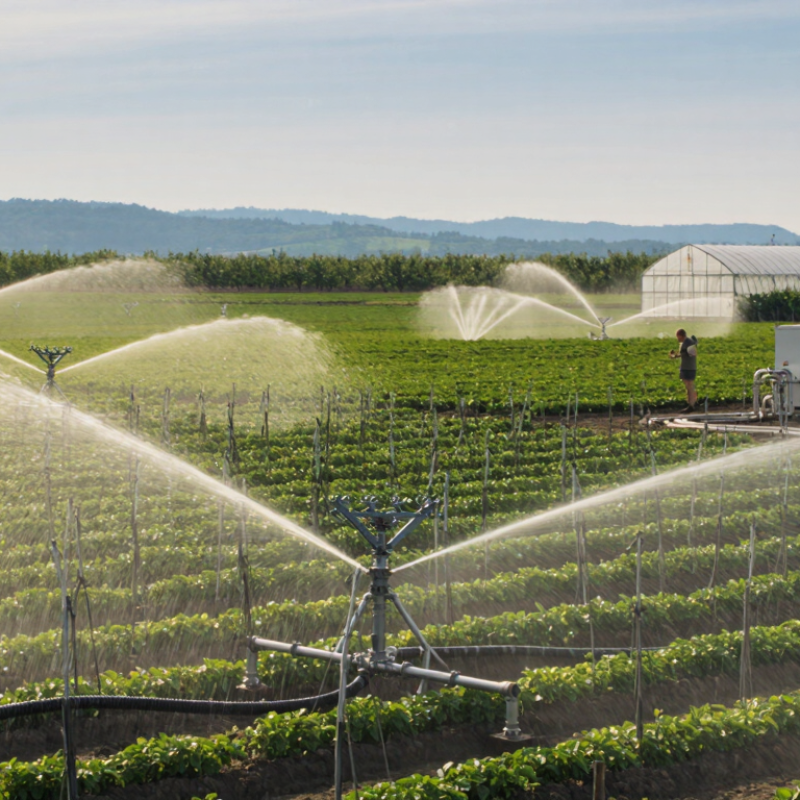
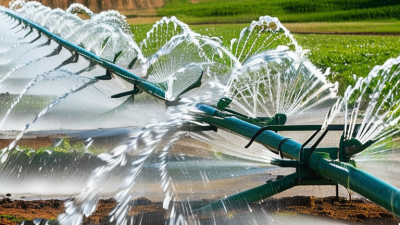
Agricultural water sprinklers are devices that distribute water across crops, soil, or planted beds. They convert pressurized water into controlled droplets. A pump pushes water through pipes, while nozzles shape the outgoing flow. Rotating sprinklers cover circular areas. Traveling systems can irrigate longer field sections. Fixed spray heads suit orchards, nurseries, and smaller plots. The design affects coverage, water use, and crop safety.
When water exits a nozzle, pressure controls its speed and reach. The nozzle opening controls droplet size and application rate. Large droplets resist wind but may disturb bare soil. Very fine droplets drift easily and can evaporate before reaching plants. Field technicians commonly check pressure with a gauge and place collection cups across the field. Uneven cup readings reveal blocked nozzles, poor spacing, or unstable pressure. Wind changes everything. A calm morning may produce better distribution than a hot afternoon.
When comparing agricultural sprinkler manufacturers in China, buyers should examine tested flow rates, pressure ranges, materials, and replacement support. Stainless steel, treated aluminum, and durable engineering plastics can serve different farm conditions. Ask for performance charts, not only attractive photographs. A practical test should measure water output from several sprinklers at the same time. Maintenance matters too. Filters need cleaning, seals require inspection, and nozzles can wear gradually. A system may look efficient while wasting water at its edges. That possibility deserves careful checking.
| Category | Data Dimension | Typical Facts or Specifications | How It Works and Why It Matters |
|---|---|---|---|
| Basic Definition | Purpose | Agricultural water sprinklers distribute pressurized water through nozzles to irrigate crops above the soil surface. | A pump or elevated water source creates pressure, and the sprinkler converts the water stream into droplets that imitate natural rainfall. |
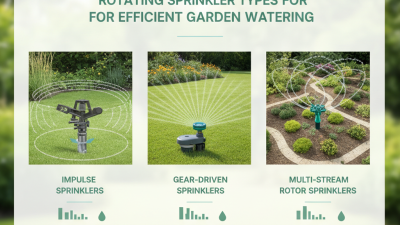
| Main Sprinkler Types | Common equipment categories | Impact sprinklers, gear-drive rotary sprinklers, fixed spray sprinklers, micro-sprinklers, traveling sprinklers, and center-pivot sprinklers. | The appropriate type depends on field size, crop height, soil infiltration rate, terrain, wind conditions, and required application uniformity. |
| Impact Sprinkler | Typical operating pressure | Approximately 2–5 bar | A spring-loaded arm interrupts the water jet and rotates the sprinkler head. It is commonly used for field crops, orchards, pasture, and open agricultural areas. |
| Micro-Sprinkler | Typical operating pressure | Approximately 1–3 bar | Small-volume emitters distribute fine streams or droplets over a localized area. They are suitable for orchards, nurseries, vegetables, and young plants. |
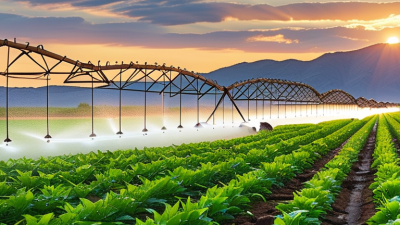
| Center Pivot | Coverage pattern | A motorized irrigation system rotates around a fixed central point and usually irrigates a circular or sector-shaped area. | Water flows through an elevated pipeline supported by towers. Sprinklers or spray devices apply water progressively across large fields with limited manual labor. |
| Nozzle | Effect on performance | Nozzle size, shape, and material determine flow rate, droplet size, throw radius, and precipitation intensity. | Larger openings generally allow higher flow at the same pressure. Correct nozzle selection helps prevent runoff, crop damage, and uneven irrigation. |
| Water Flow | Typical sprinkler discharge | Approximately 0.2–15 m³/h per sprinkler, depending on design, nozzle size, and pressure | Flow rate must be matched to the available water supply, pipe capacity, pump output, and the soil’s ability to absorb water. |
| Sprinkler Spacing | Typical layout range | Approximately 6–30 m between sprinklers, depending on sprinkler radius, wind, crop, and system design | Spacing is normally based on a percentage of the wetted diameter so that adjacent spray patterns overlap and improve uniformity. |
| Application Rate | Water applied to the soil | Common agricultural sprinkler systems are designed to apply water at a rate that does not exceed the soil infiltration rate. | If the application rate is too high, water may pond or run off. Lower rates and longer irrigation cycles are often better for compacted or fine-textured soils. |
| Filtration | Water-quality protection | Screen, disc, or media filters are commonly installed before sprinklers, especially when using surface water or recycled water. | Filtration removes suspended particles that can block nozzles and reduce flow uniformity. Required filtration depends on nozzle design and water quality. |
| Pressure Regulation | System control | Pressure regulators, gauges, valves, and pressure-compensating devices help maintain stable operating conditions. | Excessive pressure can create mist and wind drift, while insufficient pressure reduces radius and produces uneven coverage. |
| Water Efficiency | Factors affecting efficiency | Performance is influenced by nozzle selection, spacing, pressure, filtration, maintenance, wind, evaporation, and irrigation scheduling. | Uniform distribution and irrigation based on crop demand can reduce unnecessary water use compared with poorly designed or poorly maintained systems. |
| Suitable Crops | Typical agricultural applications | Field crops, vegetables, orchards, nurseries, turf, pasture, and newly established plants. | Sprinklers can provide germination moisture, frost protection, crop cooling, and routine irrigation, although some crops may be sensitive to wet foliage or high-pressure droplets. |
| Power Requirement | Energy source | Systems may use electric, diesel, solar-powered, or gravity-fed water sources, depending on the available pressure and flow. | Pumping energy is mainly affected by flow rate, total dynamic head, elevation difference, pipe friction, and operating time. |
| Maintenance | Routine actions | Inspect nozzles, clean filters, check pressure, flush pipelines, repair leaks, and verify sprinkler rotation and coverage. | Regular maintenance helps preserve application uniformity and prevents blocked nozzles, pressure losses, excessive energy use, and premature component wear. |
| Selection Criteria | Key purchasing and design factors | Consider crop type, field dimensions, soil texture, slope, water source, water quality, available pressure, required flow, climate, and automation needs. | A correctly designed system should deliver the required amount of water uniformly without exceeding the soil infiltration capacity or the available pump and pipeline capacity. |