How to Choose the Right Faucet Adapter for Global Sourcing?
Choosing the right Faucet Adapter for global sourcing requires more than matching two visible threads. A polished sample can still leak, corrode, or fail installation. The decision must connect thread standards, material safety, pressure performance, water-contact certification, and regional fit.
The 2024 WHO/UNICEF Joint Monitoring Programme report states that 2.2 billion people lacked safely managed drinking water in 2022. This highlights why material selection and contamination control cannot be treated as minor details. Grand View Research’s 2024 plumbing fixtures market analysis also identifies residential construction and renovation as major demand drivers. For buyers, that means broader volume potential, but also stronger expectations for consistency. ISO 228-1, NSF/ANSI/CAN 61, WRAS, and relevant regional requirements should guide supplier evaluation. They are not interchangeable.
Richard Trethewey, a licensed master plumber and plumbing expert with This Old House, has emphasized, “The connection has to be watertight, serviceable, and compatible with the system.” That principle is practical. A sourcing team should verify thread type, nominal size, gasket design, working pressure, surface finish, and packaging protection. Request production samples, dimensional reports, and test records before approving a large order. Confirm whether the adapter supports BSP, NPT, G, or other regional standards. Small differences matter. Even experienced buyers sometimes rely too heavily on product photos. That is a mistake worth revisiting. A reliable Faucet Adapter is not merely a cheap connector; it is a tested interface between different plumbing systems, suppliers, and user expectations.
Define Your Faucet and Plumbing Requirements
Before selecting a faucet adapter, define the faucet itself. Measure the spout outlet diameter, thread direction, pitch, and exposed length. Do not rely on appearance. Two similar aerators can use different threads. Remove the aerator and photograph the connection beside a ruler. Note whether the outlet is male, female, or threadless. This simple record prevents expensive sampling errors. It also gives suppliers clear evidence.
Then map the plumbing conditions. Record inlet size, pipe material, water pressure, and hot-water temperature. Check whether the adapter connects to an aerator, hose, filter, or washing accessory. A kitchen pull-out faucet may need a swivel-safe adapter, while a rigid bathroom outlet may need a compact fitting. Consider clearance under the sink. A connector that fits the thread may still block the handle or leak against a cabinet wall. Test with clean water at normal pressure. Small details matter.
For global sourcing, write every requirement in measurable terms. Specify thread standard, gasket material, working temperature, pressure range, finish, and inspection method. Ask for a dimensional drawing and a sample before placing a larger order. In my experience, samples reveal problems that photos hide, especially shallow threads and uneven seals. I have also trusted a correct diameter too quickly. That was a mistake. Recheck with a thread gauge and a simple leak test. Keep the test record with the purchase specification. If local plumbing differs, revise the adapter design rather than forcing a connection. Good sourcing starts with honest measurements, not optimistic assumptions.
Identify Adapter Types, Sizes, and Connection Standards
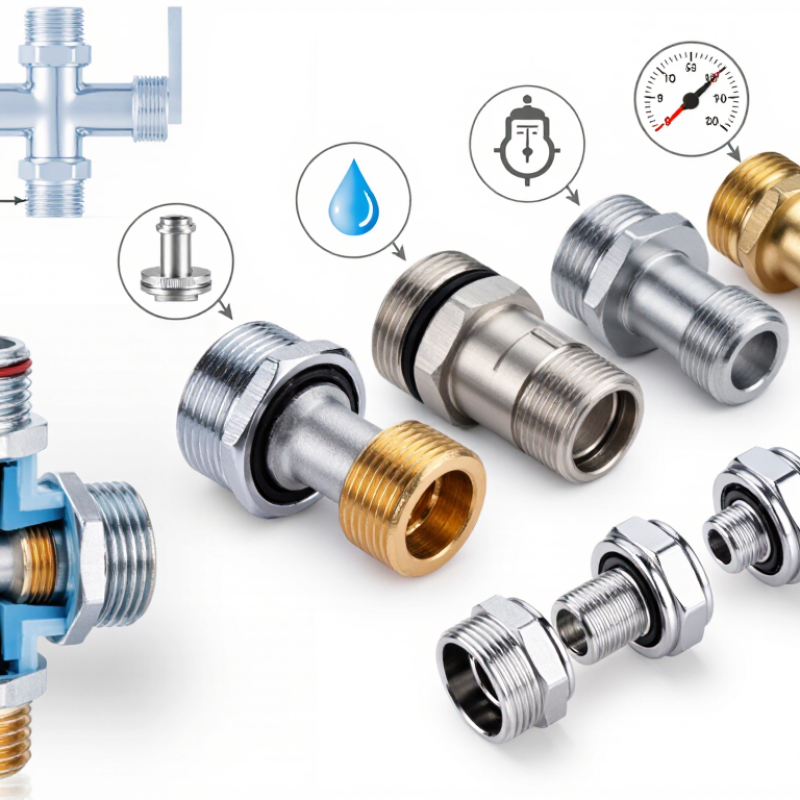
Choosing the right faucet adapter starts with identifying the faucet outlet, not guessing from a product photo. Global sourcing often involves different faucet designs, thread systems, and measurement habits. Start by identifying the adapter type: aerator adapters, hose connectors, compression adapters, or male-to-female thread converters. Each serves a different installation purpose. Do not match by appearance alone. I have seen polished fittings look identical while using incompatible threads.
Size checks should include diameter, thread pitch, and gender. Measure the outside diameter of male threads and the inside diameter of female threads. A 15/16-inch female aerator thread cannot reliably replace a 22-millimeter metric thread. Thread pitch matters too. Use calipers and a thread gauge when possible. Take clear photos. A physical sample is safer than a rushed spreadsheet.
Connection standards require careful attention. NPT threads are tapered and common in some supply chains, while BSP threads use different angles and pitch conventions. G threads are usually parallel, but sealing may depend on a washer rather than the thread itself. Compression fittings and quick-connects need their own matching components. Ask suppliers to state the standard, dimensions, material, and sealing method in writing. Stainless steel, brass, and approved engineering plastics may suit different water conditions. I prefer testing a small batch before placing a large order. A perfect specification sheet is not enough. Real fittings can still reveal tolerance problems during installation.
Compare Materials, Seals, and Compatibility Factors
Global faucet sourcing often fails at the adapter, not the faucet. An adapter must match thread size, thread standard, water pressure, and installation space. Measure the outlet with a caliper, not a ruler. A one-millimeter error can cause leakage or forced assembly. Check whether the connection uses parallel or tapered threads. These designs do not seal in the same way. During inspections, record dimensions from several samples because production variation is real.
Material choice affects corrosion resistance, strength, and service life. Stainless steel suits humid kitchens and repeated installation. Brass offers good machining performance and stable threads. Engineered polymers reduce weight, but they need pressure and temperature testing. Avoid judging material by appearance alone. Plating can hide a weaker base metal. Request composition reports and sample test results. Seals deserve equal attention. EPDM performs well with hot and cold water, while silicone remains flexible across wider temperatures. Nitrile may suit certain systems, yet compatibility must be verified. The wrong seal can swell, flatten, or crack. Small detail.
Compatibility also includes hose geometry, washer thickness, flow path, and tool access. Test the adapter on the actual fixture, not only a drawing. Run pressure cycles, then inspect the joint after cooling and reheating. I once treated a washer as a minor part; it changed the sealing height and caused dripping. That mistake was avoidable. Request dimensional drawings, seal data, and batch inspection records from suppliers. Keep samples from every shipment for traceability. No adapter is universal.
Evaluate Global Sourcing, Certifications, and Supplier Quality
How to Choose the Right Faucet Adapter for Global Sourcing?
Global sourcing requires more than matching thread sizes. The WTO reported that world merchandise trade volume declined by 1.2% in 2023. Freight uncertainty makes wrong samples expensive. I check thread type, working pressure, temperature range, and water-contact materials before comparing prices. Fit is not enough.
Certification requirements vary by destination and application. A potable-water adapter may need evidence for material safety, pressure performance, and chemical migration. Ask for the complete certificate, test standard, factory address, model range, and validity period. A logo alone proves little. The ISO Survey 2022 recorded more than 1.2 million ISO 9001 certificates worldwide, yet certification does not guarantee every batch is consistent. Certificates can expire.
Supplier quality needs physical verification. Request material reports, dimensional records, leak-test results, and traceability codes. During sampling, measure thread engagement with calibrated gauges, then test repeated installation cycles. The World Bank’s Logistics Performance Index 2023 shows clear differences in customs, tracking, and delivery reliability across markets. These differences affect replenishment planning. I have seen suppliers pass a visual check but fail pressure testing. That mistake is easy to miss. Require a documented corrective-action process, and inspect production samples before shipment. Still, no checklist is perfect; local water conditions and installer habits can expose weaknesses later.